- Short answer
The DOT physical checks a driver against 13 standards in 49 CFR 391.41(b), covering limbs, diabetes, heart, lungs, blood pressure, bones and muscles, seizures, mental health, vision, hearing, drugs and alcohol. The examiner records the results on Form MCSA-5875 and, if the driver qualifies, issues the certificate on Form MCSA-5876.12 The visit itself usually runs through history, vitals, vision, hearing, a urine test and a hands-on exam.
- Prices checked
- November 20, 2026. One clinic page lists $110 for the exam (source 4). Clinics set their own prices.
- Rule checked
- November 20, 2026, 49 CFR 391.41 and 391.43
- Applies to
- Drivers of commercial motor vehicles in interstate commerce who must hold a medical examiner's certificate. This page is general information, not medical advice.
On this page
- 01What is the examiner actually deciding?
- 02What are the 13 standards in plain words?
- 03Which forms are involved?
- 04What happens during the visit?
- 05Who is allowed to do the exam?
- 06What does the exam cost?
- 07What if the examiner cannot decide that day, or finds the driver not qualified?
- 08More on the DOT physical
- 09Questions people ask
What is the examiner actually deciding?
The question on the table is narrow. Does anything about this person's health make it unsafe to operate a commercial motor vehicle? The rule says a person is physically qualified if they meet the standards in 391.41(b) and have complied with the exam rules in 391.43.1 The examiner must know the physical and mental demands of the job and must use the medical protocols needed to do the exam properly.2
The exam is not a drug test and it is not a fitness test. A clinic page that walks through the visit says the urine sample is checked for protein, blood and sugar to screen for kidney disease and diabetes, and says plainly it is not a drug screen.4 The DOT drug test is a separate process, covered on the DOT drug test page.
What are the 13 standards in plain words?
These come straight from 391.41(b)(1) to (13). The wording below is ours, the numbers and limits are the rule's.
| 391.41(b) | What the rule says, in plain words | |
|---|---|---|
| (1) | No loss of a foot, leg, hand or arm, unless a skill performance evaluation certificate was granted under 391.49 | |
| (2) | No hand, finger, arm, foot or leg impairment that interferes with gripping or with the normal tasks of driving a CMV | |
| (3) | No history or diagnosis of diabetes currently treated with insulin, unless the driver meets 391.46 | Diabetes and insulin |
| (4) | No current diagnosis of a heart or circulation disease of the kind known to cause fainting, shortness of breath, collapse or heart failure | |
| (5) | No history or diagnosis of a breathing problem likely to interfere with controlling and driving a CMV safely | |
| (6) | No current diagnosis of high blood pressure likely to interfere with driving safely | Blood pressure |
| (7) | No rheumatic, arthritic, orthopedic, muscular, neuromuscular or vascular disease that interferes with controlling and operating a CMV safely | |
| (8) | No history or diagnosis of epilepsy or any condition likely to cause loss of consciousness or loss of control | |
| (9) | No mental, nervous, organic or functional disease or psychiatric disorder likely to interfere with driving safely | |
| (10) | Distant acuity of at least 20/40 in each eye and in both eyes, a 70 degree field of vision in each eye, and the ability to recognize red, green and amber | Vision |
| (11) | Hears a forced whisper in the better ear at 5 feet or more, or has an average loss of no more than 40 decibels at 500, 1,000 and 2,000 Hz | Hearing |
| (12) | No use of Schedule I drugs, amphetamines, narcotics or other habit-forming drugs, and no use of other scheduled drugs unless prescribed by a licensed practitioner who knows the driver's history and has advised that the drug will not affect safe driving | |
| (13) | No current diagnosis of alcoholism |
Source 1, 49 CFR 391.41(b), opened November 20, 2026. Several standards are written as "likely to interfere", so the examiner uses medical judgment on them.

Life insurance for drivers
Licensed agents compare several insurance companies and call you back with prices. You decide.
Get a life quoteOr call (305) 699-5857Which forms are involved?
Three forms matter, and the rule names each one.
- MCSA-5875, the Medical Examination Report. The exam and its results are recorded here. The examiner dates and signs it and adds a full name, office address and phone number.2
- MCSA-5876, the Medical Examiner's Certificate. This is the card. If the driver qualifies, the examiner completes it and gives the original to the driver. An employing carrier can ask for a copy.2
- MCSA-5850, the results form. The examiner sends this to FMCSA electronically, by midnight local time of the next calendar day after the exam.2
J.J. Keller reported that updated versions of the 5875 and 5876 were posted April 1, 2025 and expire March 31, 2028, and that examiners could keep using the old forms until their supply ran out.5 The examiner keeps each report and certificate copy for at least 3 years and must produce them within 48 hours of an official request.2
What happens during the visit?
Clinic pages describe the same basic order.34
- Check-in and history. The driver fills in the health history on the form, covering conditions, surgeries, symptoms and medications. The examiner reads it before the hands-on part.
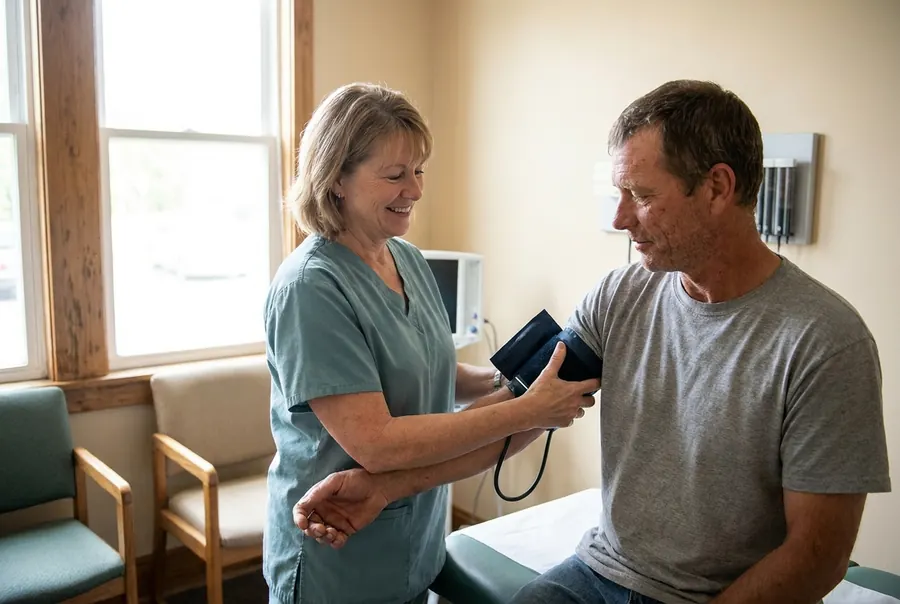
- Vitals. Height, weight, pulse and blood pressure are recorded.
- Vision. Acuity in each eye and both eyes, field of vision, and traffic signal colors.
- Hearing. A forced whisper test or an audiometer.
- Urinalysis. A screen for protein, blood and sugar, not for drugs.
- Physical exam. The examiner goes through the body systems listed on the form and watches simple movements that show function.
- Decision. Qualified, not qualified, or pending while more information is gathered.
The history section is the driver's to answer, fully and accurately. Questions about what a condition means for the exam belong with the examiner and the driver's own doctor.
The clinic pages say to bring photo ID, a medication list with doses and the prescriber, any glasses, contacts or hearing aid used for driving, letters or test results for a condition under care, and any FMCSA exemption or skill performance evaluation paperwork.34
Who is allowed to do the exam?
The exam has to be done by a medical examiner listed on the National Registry of Certified Medical Examiners.2 Two exceptions are written into 391.43(b). A licensed ophthalmologist or optometrist may perform the vision part, and a certified VA medical examiner may examine veteran operators only.2 Since May 21, 2014, a listed examiner has been required, and the registry's online database is searchable by location.6
What does the exam cost?
The rule sets no price. Clinics set their own. One occupational medicine clinic page we opened on November 20, 2026 lists $110 for the exam and says it takes 30 to 60 minutes, longer if an EKG, specialist letter or lab work is needed.4 Treat that as one dated sample, not a market rate. Employer programs, truck stop clinics and urgent care centers may charge differently.
What if the examiner cannot decide that day, or finds the driver not qualified?
If the examiner needs more information or more testing, the decision can be delayed. The driver is told the information must be provided or the further exam completed within 45 days, and that the pending status will be reported to FMCSA.2 A clinic page warns that pending status does not extend a certificate that is about to expire.3
If the examiner finds the driver not physically qualified, the driver must be told that, and that it will be reported to FMCSA. All certificates previously issued to the person are no longer valid.2 Part 391 has its own route for a dispute between a driver and a carrier's examiner, in 391.47, which requires an impartial medical specialist's report and leaves the driver treated as disqualified until FMCSA decides.7
More on the DOT physical
Questions people ask
Is the DOT physical a drug test?
No. The urine sample is checked for protein, blood and sugar. The DOT drug test is a separate collection with its own rules under Part 40.
Can my regular doctor do the exam?
Only if that doctor or clinician is listed on the National Registry of Certified Medical Examiners. Otherwise the certificate does not satisfy the rule.
How long is the card good for after the exam?
Up to 24 months, or less when the examiner wants to monitor a condition. The medical card page has the lengths and the special cases.
Do I need the exam if I only drive inside my state?
That depends on your state's rules and your license category. The federal rule covers interstate operations, and the self-certification choices are laid out on the medical card page. Ask your carrier or your licensing agency which applies to you.
The truck has its own yearly exam. The guides on the DOT Annual home page cover the annual inspection of the vehicle.
Sources (7)
- Cornell Law School Legal Information Institute, 49 CFR 391.41 Physical qualifications for drivers, opened November 20, 2026. law.cornell.edu
- Cornell Law School Legal Information Institute, 49 CFR 391.43 Medical examination and certificate of physical examination, opened November 20, 2026. law.cornell.edu
- DOT Compliance Companies, What Does a DOT Physical Consist Of, August 28, 2026, opened November 20, 2026. dotcompliancecompanies.com
- WorkOccMed Medical Group, What Happens at a DOT Physical Exam, step by step guide, opened November 20, 2026. dot-physical.net
- J.J. Keller, 2 hot FMCSA medical news updates, April 2, 2025, opened November 20, 2026. jjkeller.com
- Heavy Duty Trucking, Drivers Physicals Must Now Be Performed by Certified Medical Examiners, May 21, 2014, opened November 20, 2026. truckinginfo.com
- Cornell Law School Legal Information Institute, 49 CFR 391.47 Resolution of conflicts of medical evaluation, opened November 20, 2026. law.cornell.edu